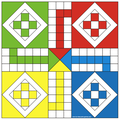
Ludo is a traditional strategy game played by 2 to 4 players. Combining simple rules with an element of chance, Ludo is one of the world's most popular board games.
Ludo originated as a simplified adaptation of the ancient Indian game Pachisi. While Pachisi traditionally used cowrie shells,
partnership play, and more complex movement rules, Ludo was redesigned as a faster and more accessible game.
The modern version was patented in England in 1896 by Alfred Collier and marketed under the name "Ludo", derived from the Latin word meaning "I play".
In 1914, Josef Friedrich Schmidt created an even simpler version in Germany, Mensch ärgere Dich nicht ("Don't Get Angry"), which became hugely popular after thousands of copies were
distributed to soldiers and military hospitals during the First World War.
During the twentieth century, the game spread throughout the world and became known under various names and local adaptations. Today, Ludo remains especially popular in Europe, South Asia,
and many other regions, both as a physical board game and in digital formats.
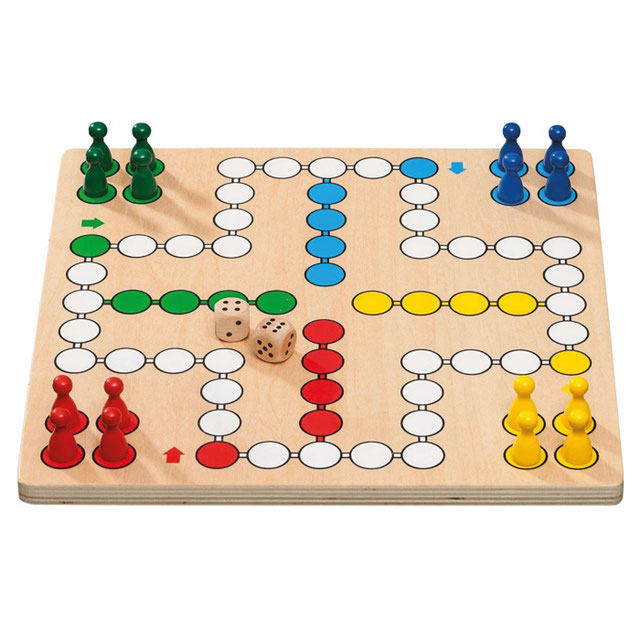
In Ludo, each player controls four tokens of a single colour and competes to move them from their starting area to the central finish zone before their opponents. The game requires a square
board with a cross-shaped playing track, sixteen tokens in four colours, and a single six-sided die.
At the start of the game, each player's four tokens are placed in a coloured starting area, often called the yard or base. Players take turns rolling a single die.
To bring a token onto the board, a player must usually roll a six, placing one token on the starting square of their colour. Once in play, tokens move clockwise around the outer track
according to the number rolled on the die.
Landing on a square occupied by an opponent's token captures it and sends it back to its starting area, requiring another six for it to re-enter play. Some versions also include safe
squares where tokens cannot be captured.
After completing a full circuit of the board, tokens enter their coloured home column and must reach the central finish area using an exact roll. The first player to bring all four tokens to
the centre wins the game.
Although luck plays an important role through dice rolls, players must make strategic decisions about which token to move, when to advance aggressively, and when to protect vulnerable pieces.