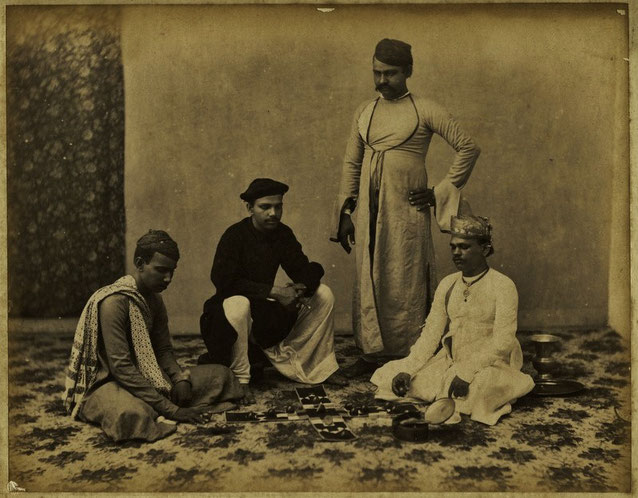
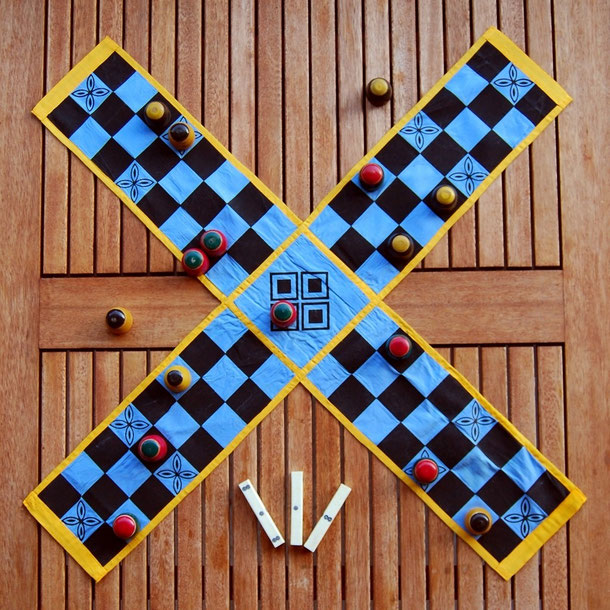
Pachisi (Pechisi) is a traditional race and strategy board game originating from India. It is most commonly played by 2 or 4 players, with the four-player version traditionally played as a
partnership game in which teammates sit opposite one another.
The game requires a cross-shaped board, four playing pieces (such as beads, beans, or other markers) for each player or team, and six equally sized seashells used instead of dice. The
objective is to move all of one's pieces around the board and into the central goal area before the opposing player or team.
Pachisi is widely regarded as one of the oldest board games in the world, with origins in the Indian subcontinent dating back several centuries. The game is believed to have developed from
even older Indian cross-and-circle race games and became especially popular during the Mughal Empire. Historical accounts describe the sixteenth-century Mughal emperor Akbar playing a life-sized
version of Pachisi on the courtyards of his palaces, using servants and court attendants as living playing pieces.
The game's name derives from the Hindi word pachis, meaning “twenty-five,” referring to the highest score obtainable in a single throw of the shells.
As the game spread beyond India, it gave rise to numerous regional variants and adaptations. In the nineteenth century, Pachisi was introduced to Europe and North America, where simplified
versions were developed, including Parcheesi in the United States and later Ludo in Britain. Today, related forms of the game are played around the world, including
Parchís in Spain and Parqués in Colombia, while in Turkey the traditional form is known as Peçiç and remains particularly popular in the southeastern provinces of Gaziantep,
Kilis, and Kahramanmaraş.
Players or teams sit opposite each other around the cross-shaped board and begin with four pieces each. To enter a piece into play, a player must roll either a 25 or a 12.
Pieces are moved according to the value obtained from the seashell throw. Certain spaces on the board are marked with crosses, indicating safe zones where pieces cannot be captured. On
unmarked spaces, however, an opponent may capture a piece by landing on the same square, forcing it to return to the starting position.
Pieces travel along the outer track of the board and, after completing a full circuit, enter their home lane toward the center. A piece is considered safe once it reaches the central goal
area. The first player or team to bring all of their pieces to the center wins the game.
The main scores that can result from a seashell throw are 25, 12, 8, 4, 3, and 2. Some outcomes grant additional movement or an extra throw, while special rules apply if a player throws 12 or
25 three times consecutively.
Depending on the pace of play, a typical game lasts around two hours.
Today, commercial versions of the Pachisi board are available in a variety of colors and designs, although traditionally handmade cloth boards are often regarded as the most authentic. Rules
may vary between regions and countries, resulting in numerous local variations of the game.