
An Overview Western Philosophy of Play (E.Ryall, W.Russell, M.MacLean)
What you will read below are selected parts from the introduction to the book The Philosophy of Play (Routeledge, 2013). Full text of the introduction is available for download below.
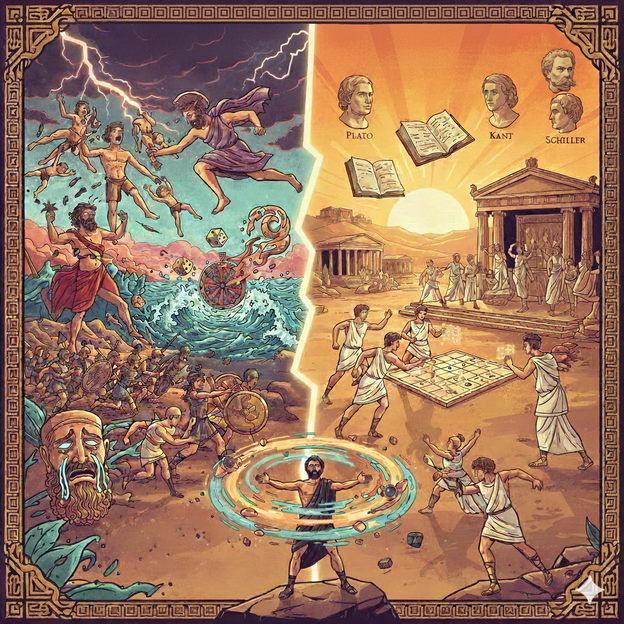
In his seminal work on play in modern philosophical discourse, Mihai Spariosu (1989) contends that the history of western philosophising on play can be understood alongside and in relation to the history of western mentality, and that this has oscillated between a pre-rational and a rational pole, with cultural paradigm shifts occurring alongside periods of crisis in established values.
In archaic, pre-Socratic, pre-rational Greece, play was the prerogative of violent, unpredictable gods who used people as their playthings. The primary pre-rational play concept is agon, the violent play of the forces of Nature (or gods) and the immediate competition of war... In its rational form, competition becomes mediated through symbolic sports and games with rules. Closely linked to agon is what Spariosu terms chance-necessity, sometimes referred to as alea (Caillois 1961) or chaos (Sutton-Smith 1997): the unpredictability of the kosmos and the struggle to survive against the whims of the gods and/or natural forces. In its rational form, this becomes rule-bound games of chance and risk-taking. In both agon and alea/chaos, might wins out in pre-rational forms, whereas justice and ideas of fair play regulate rational forms. Mimesis refers to what we now know, in rational play discourse, as performance and representations of life through various forms of art, literature or play. Spariosu suggests that pre-rational mimesis was less a representation of life and more an imitative performance intended to ‘presence’ something, in the sense of invoking or calling forth… Spariosu’s final play concept is play as freedom. In its pre-rational guise, this is linked to the unconstrained play of forces in agon and alea-chaos: the sense of freedom is closely linked to displays of power. In its rational form, freedom is both contained within social conventions... and also seen as a release from everyday responsibilities.
Ancient Greece and early Rome, seen as the dawn of western thought, were predominantly pre-rational, whereas Hellenistic Greece and Imperial Rome were for the most part rational (Spariosu 1989). As an illustration, Plato’s rational epistemology sees playing as the route to learning… This is the rationalisation of as if…
Such ideas re-emerge towards the end of the Age of Reason and into the period of German Idealism… For Kant, ‘mere play’, such as in the competitive agon of metaphysicians, does not have a place in the necessary thoroughness of serious philosophy... This is a cautious endorsement of a particular form of playing aimed at higher order activity…
Schiller (2006) develops Kant’s ideas on the relationship between play and aesthetics and suggests that what he calls the ‘play drive’ can mediate between natural, physical drives and logic... This is, again, a rationalisation of both as if and mimesis play forms, and although it extends Kant’s original ideas beyond the cognitive into the sensual and practical, it is still reason that dominates… Rational forms of play are to be exalted, pre-rational forms are to be constrained as mere play, a class-based theme that arguably persists today in the concepts of high and low (or indeed adult and child) culture.
If Plato, Kant and Schiller provide examples of the rationalising of play, then Nietzsche can offer a paradigmatic foundation for the return to pre-rational philosophizing on play and power. For Nietzsche the world is at play and this divine game is the chaotic, arbitrary, agonistic and violent play of the forces of the world and the Will to Power. He retains the aesthetic perspective of Kant and Schiller, but returns it to its original meaning of sensations (as the opposite of thought) rather than beauty, thereby inverting ‘the Platonic-Kantian hierarchy of metaphysical values: the play of the senses and the imagination gains priority over the play of understanding and reason’ (Spariosu 1989: 75).
