
Oranges and Lemons

- Oranges and Lemons is a traditional singing game played by groups, typically with six or more players, without any materials. The game requires an open space and is structured around coordinated movement, rhythm, and collective singing.
- “Oranges and Lemons” is a well-known English nursery rhyme and game, first printed in the mid-18th century. Its lyrics refer to the bells of churches in London, embedding the game in the soundscape and social life of the city.
- The structure of the game, however, is much older and part of a widespread tradition of arch-and-capture games across Europe. One of the earliest known precursors is the Italian “code romana” from the 14th century, a bridge-like game involving passage and sudden capture. Over time, this structure spread and evolved into many local forms, including the English “Oranges and Lemons” and the closely related “London Bridge” game. It is suggested that these games preserve symbolic elements of passage, negotiation, and selection, embedded in playful group activity.
- The rhyme’s final lines, referring to execution, have often been interpreted as echoes of historical punishment practices. At the same time, the repeated passing through a “gate” and the moment of capture reflect broader symbolic ideas such as transition, belonging, and exchange.
Gameplay
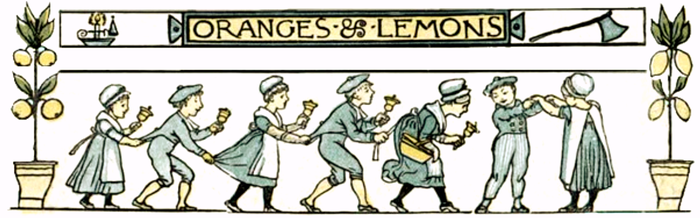
- Two players form an arch by raising and joining their arms. The remaining players form a line and pass underneath the arch while singing the nursery rhyme, typically beginning with “Oranges and lemons, say the bells of St Clement’s…” and continuing through verses naming different churches.
- The arch remains open throughout most of the song, creating a sense of anticipation. On the final line – often “Here comes a chopper to chop off your head” – the two players suddenly drop their arms, capturing whoever is passing through at that exact moment. This moment of capture is synchronized with the rhythm and final beat of the rhyme, making timing and suspense central to the experience.
- The captured player is then assigned to one of the two sides, typically by choosing between two hidden options. The process repeats until all players are divided into two groups. The game concludes with a tug-of-war or pulling contest between the groups, transforming the rhythmic play into a physical team challenge.
Variations
- Across cultures, the same structure appears with different narratives and symbolic meanings. In England, the game reflects urban life and church bells; in other regions, it may involve bridges, gates, merchants, or negotiations. Players may pass individually or in pairs, and captured players may either form teams or join the arch. Despite these variations, the core mechanics – movement, rhythm, capture, and group division – remain consistent across time and geography.
Sources
- For more details, historical variations, and full lyrics, explore the links and sources below.
- Wikipedia. “Oranges and Lemons”
- Britannica Editors. "London Bridge". Encyclopedia Britannica, 3 Jan. 2008,
- Opie, I., & Opie, P. (Eds.). (1973). The Oxford dictionary of nursery rhymes (2nd ed.). Clarendon Press. p.270-276
- Youtube. Oranges and Lemons: Dark Secrets Hidden in the Nursery Rhyme